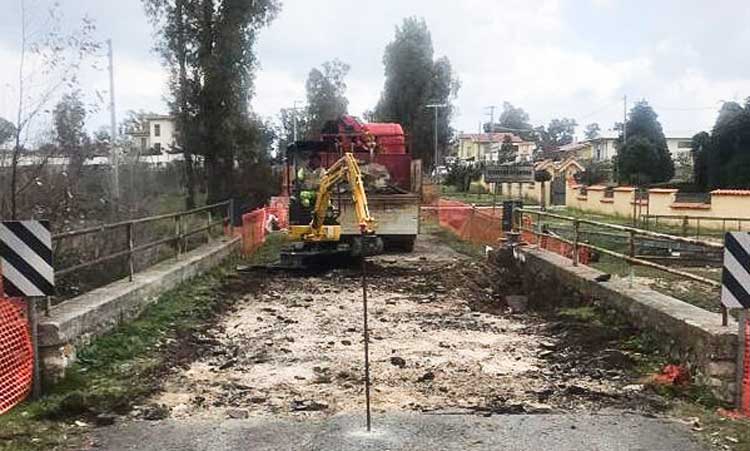
One hundred kilos of explosives, dating back to the Second World War, a quantity of dynamite capable of blowing up the Mascarello bridge, between Latina and Cisterna, in case of need.
It’s been 79 years but the dynamite was still there, in all its danger. This was discovered by the company in charge of securing and consolidating the bridge that divides the territory of the municipalities of Latina and Cisterna, which find obliged the workers to suspend the reconstruction effort and ask for the intervention of the bomb squad.
The explosives were near the pylon of the bridge and would have been blown up in the event that the Americans had passed through those parts immediately after the landing of Anzio on January 22, 1944.
The Allies instead took a different path, or perhaps passed over that bridge in an unexpected way, evidenced by the fact that since those tragic months between January and May of 1944 when the planted explosives were set, ready to sow destruction and death, and which remained in place until the past few days. And it’s a miracle that nothing has happened in all these years.
What does history say?
History recalls that on January 30, 1944 two battalions of US Army Rangers made their way to Cisterna, and were counting on being able to find little resistance and take the town to operate with the other units advancing from Aprilia and Campoleone in a pincer maneuver against the Germans deployed on the Vastelli Romani.
But the Germans had foreseen the intent and had strongly fortified themselves at night in Cisterna. The Rangers’ attack was a carnage: of the 767 soldiers deployed, only 6 returned back to the Allies’ lines. The others were all killed or captured.
And it can be hypothesized that precisely this overwhelming and, in some ways unexpected victory of the Germans, led to the saving of the bridge, the destruction of which at that point was no longer necessary. The dynamite, well hidden, was not used and remained hidden there to the present day
Friends make people happy, but happy people find it easier to make friends. And it is that complex set of human ties that creates the environment of support, good feeling, resilience, trust that make up the matrix of a happy life.
This finding is backed up by one of the longest of all longitudinal research exercises, the Grant Study, begun in 1938, which has tracked the lives of 268 Harvard students — at that time, Harvard was a male-only college — for more than eighty years, seeking to understand what characteristics — from personality type to intelligence to health, habits and relationships contribute to human flourishing.
For over thirty years, the project was directed by George Vaillant, whose books Aging Well and Triumphs of Experience have explored this fascinating territory.”
In an interview published in the March 2008 newsletter to the Grant Study subjects, Vaillant was asked, “What have you learned from the Grant Study men?”
Vaillant’s response was, “That the only thing that really matters in life is your relationships to other people.”
A 2017 summary of the study concluded: “Close relationships, more than money or fame, are what keep people happy throughout their lives … Those ties protect people from life’s ‘ discontents, help to delay mental and physical decline, and are better predictors of long and happy lives than social class, IQ, or even genes.”
The ‘Nun study’
Given the discontent that we have seen to be inherent in a market-led, sensation-driven, pleasure-seeking approach to happiness, what is there to be said for a recovery of the older Philosophical and religious tradition that sees happiness in terms of a life well led?
A powerful piece of evidence is to be found in one of the most famous medical research exercises of recent times, known as the Nun Study.
Directed by David Snowdon of the University of Kentucky Medical Centre, it studied the health Pattern of some seven hundred nuns of the School Sisters of Notre Dame, with particular reference to Alzheimer’s disease. The nuns were aged between 75 and 107, and what gave the study its fascination and depth was the access the researchers had to their autobiographies, written when they were in their early twenties, more than half a century earlier,
This particular Order required Novitiates to write a brief account of their lives on entering the order, and the researchers used linguistic analysis to draw a Picture of their Personalities at that early age.
One of their findings was that the more the early autobiographies expressed positive emotions like gratitude, happiness, hope and love, the more likely the nuns were still to be alive sixty years later. The correlations they discovered were so specific that they were able to predict with 85 per cent accuracy which of the nuns would develop Alzheimer’s and which would not.
The difference in life expectancy between the thankful and (relatively) thankless was, on average, seven years. Being grateful adds years to your life.
From chapter 4, ‘Consuming happiness’ from the book: –
An army general visited one of the field kitchens of one battalion under his command. While eating breakfast with the soldiers, he was impressed to see the army’s insignia stamped on every biscuit.
He went to the Senior NCO cook to ask how this feat was done, so it could be used at other battalions’ field kitchens under his command.
The SNCO chief cook replied, “I’d be glad to share that with you, General. After each biscuit is cut, I just slap it here against my belt buckle which bears the army insignia.
Horrified, the General exclaims, “That’s very unhygienic!”
The SNCO chief cook shrugs and replies, “Well, If that’s the way you feel, sir, I suggest you avoid the donuts.”
Bud and Jim were a couple of drinking elderly buddies who worked as aeroplane mechanics in Atlanta.
One day the airport was fogged in and they were stuck in the hanger with nothing to-do. Bud said, “Man, I wish we had something to drink!”
Jim says, “Me too. I know, I’ve heard you can drink jet fuel and get a buzz. You wanna try it?”
So they pour themselves a couple of glasses of high octane stuff and get completely smashed.
The next morning Bud wakes up and is surprised at how good he feels.
In fact, he feels GREAT! NO hangover! NO bad side effects. Nothing!
Then the phone rings… It’s Jim. Jim says, “Hey, how do you feel this morning?” Bud says, “I feel great. How about you?”
Jim says, “I feel great, too. You don’t have a hangover?” Bud says, “No, that jet fuel is great stuff – no hangover, nothing. We ought to do this more often.” “Yeah, well there’s just one thing…” “What’s that?”
“Have you farted yet?” “No…” “Well, DON’T, ’cause I’m in PHOEN!X!!!
Ozzy Osbourne has sent an update for his worried fans, three days after undergoing extensive surgery to realign pins put in his neck and back.
“I am now home from the hospital recuperating comfortably,” the Prince of Darkness wrote in a statement shared through his social media. “I am definitely feeling the love and support from all my fans and send everyone a big thank you for their thoughts, prayers and well wishes during my recovery.”
Sharon Osbourne, Ozzy’s wife, released a statement on Tuesday, stating that the operation went well and that her husband was on his way to recovery.
“Your love means the world to him,” she said.
The procedure Monday was at least the third spinal operation Ozzy has gone through since injuring his neck in a trip-and-fall in 2019. Ozzy recalls being in such agony after the injury that he was certain he was going to die.
He’s hoping that this newest treatment will allow him to return to the stage after years of being unable to “walk properly.”
The operation and Ozzy’s forthcoming recuperation, according to Sharon, will “define the remainder of his life.”
Photo: Getty Images North America
Before he can begin recovery, Ozzy will allegedly require round-the-clock nursing care for many weeks. He hasn’t given a complete performance since 2018, despite the fact that he’s released two new studio albums after his accident in 2019.
The 13th solo album from the Black Sabbath cofounder and Rock & Roll Hall of Famer is set to be released in September.
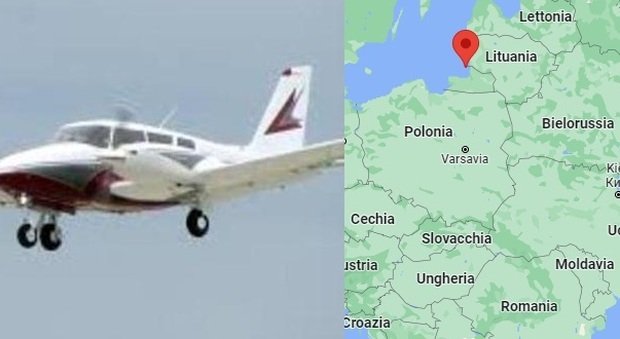
A twin-engined aircraft with its transponder switched off flew over seven European countries. Accompanied by fighter jets, it landed in Bulgaria: police found no one on board.
Lithuanian news broadcaster LRT on June 10, 2022, the unidentified plane appeared to be a Piper PA-23–250-Aztec twin-engined light aircraft, which was previously registered as LY-LOO. Its manufacturer’s serial number is 27-2250. The aircraft was misidentified as a Beechcraft in earlier reports published by Romanian and Hungarian media.
For a whole day, the aircraft flew over the skies of Eastern Europe, but it did not communicate with any control tower or interfaced with their radars. The ghost plane that took off from Lithuania on June 8 with two Russian-speaking individuals on board, remains an unsolved mystery. It crossed seven NATO countries and landed in Bulgaria, escorted – but not shot down – by Hungarian and Romanian military fighters and never responded to any signals. There were no passengers on board once it landed in Sofia. When the Bulgarian police checked the aircraft, the engine still hot.
The Piper twin-engined phantom plane
The phantom aircraft was a twin-engined, six-seater Piper PA-23–250-Aztec. The small aircraft had belonged to the director of Nida Airfield, Bronius Zaromskis, who claims to have sold it very quickly to an unidentified Russian-speaking customer during the last week in Panevezys, northern Lithuania.
Zaromskis told local media that the three men who arrived to inspect the plane before purchase were not Lithuania nationals.
“I cannot guess which country they were from. They might be Ukrainians, maybe Romanians or Bulgarians. I was speaking to one of them in the Russian language. But I don’t know the names of any of these men, I was not interested,” the plane’s former owner was cited as saying by LRT.
He added: “I’ve been trying to sell that plane for years, I had nowhere to store it, so I’m glad somebody bought it. I don’t remember the name of the company which bought it.”
The Nida airfield is not far from the Russian base of Kaliningrad (an enclave of Russian territory in the middle of Europe), he told the press. The payment was made through a convenient company, making the real buyers untraceable.
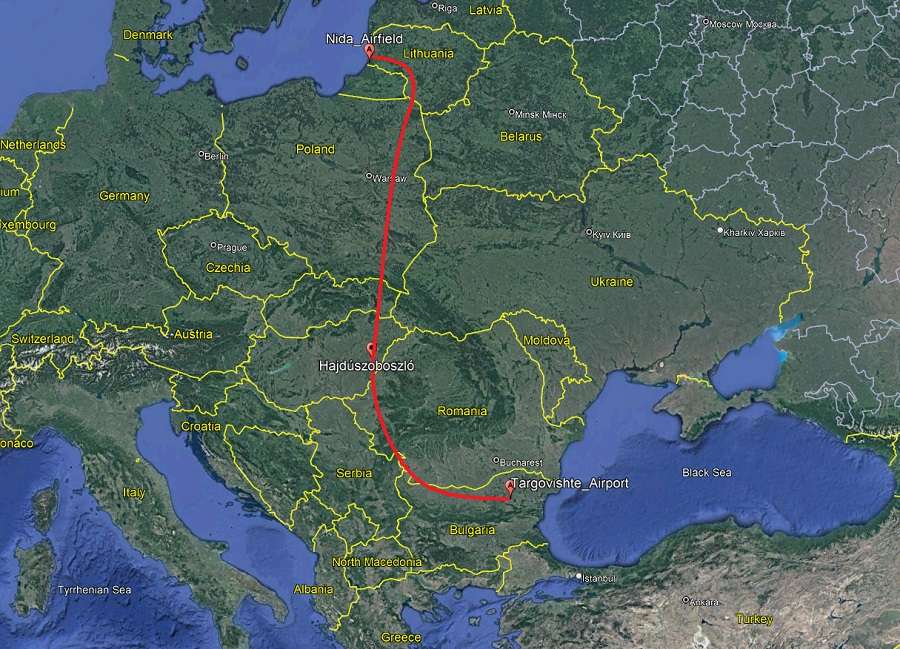
The pirate plane’s flight route took it over 7 European states
After the purchase, there are few traces available in this story. It is certain that the plane took off from Lithuania on June 8, with two Russian-speaking passengers on board.
Speaking to Lithuanian media, Oro Navigacija, a local state-owned company that provides air traffic, communication, navigation, and surveillance services in the region, said it does not have any data related to the flight, although it reportedly took-off from Lithuania on June 8, 2022.
However, it is thought that the plane did not take-off from any of the three main civil Lithuanian airports – Vilnius (VNO), Kaunas (KUN), or Palanga (PLQ). Instead, it could have left the country via any one of the country’s minor airfields.
The first unauthorisedlanding and chase in Hungary
Flying low and with all signalling systems off, the Piper escaped control systems, flew over Poland and reappeared on radar in Slovakia and Hungary. According to Hungarian press, the aircraft entered Hungarian airspace from Slovakia and in the afternoon landed at Hajdúszoboszló Airport without permission.
The pilot then threatened an airport worker who called the police. When the police arrived and approached the plane, the pilot “gave it full throttle and took off” at around 17:30 hrs., violating all flight rules, according to a report by Rtl.hu.
According to the Romanian Ministry of National Defence, the plane had no confirmed flight plan and did not respond to any attempts to establish radio communication, and ignored all visual signals. However, it “did not show hostile or dangerous behaviour”.
Then, a pair of Hungarian Air Force Saab JAS 39 Gripen fighter jets chased it: attempts to get in touch with the crew were in vain, the plane did not respond. From the base of Feteşti, US fighter jets also take flight, then Romanian ones.
The military planes escort the mysterious flight, but the phantom aircraft’s transponder remains off and there will be no way to get in touch with its two passengers on board.
Saab JAS-39 Gripen
Bulgarian media reported that at around 17.49 CET the plane entered Romanian airspace in the vicinity of Oradea. As per a cross-border agreement between Romania and Hungary, the Hungarian jets continued to accompany the mystery plane. Several minutes later, it was intercepted by two patrolling US Air Force F-16 Fighting Falcons from 86th Feteşti Air Base.
At around 18:36 CET, the surveillance was taken over by two Romanian Air Force F-16s. While being followed, the aircraft entered Serbian airspace for two minutes in an area between Drobeta-Turnu Severin and Korbovo.
The plane is then seen again over Serbia and then at 19:09 hrs in Bulgaria. No Bulgarian Air Force fighter jets were scrambled and no alarm was raised.
“At no time the plane was a threat to the civilian or military infrastructure of Bulgaria. It was flying at a low altitude, difficult to catch by fighters, but we monitored it at all times. We located where it landed and are working to establish the circumstances,” Bulgarian Minister of Defense Dragomir Zakov told Bulgarian media on June 9, 2022.
In Targovishte, Bulgaria, the plane lands on an unused runway at Buhovți Airport, a small airport. But when the police arrive it’s too late. The engine is still hot, but no one is on board: the two pilots had disappeared. The plane was reportedly found covered with a tarpaulin with no signs of any crew or passengers.
The Prosecutor’s Office of Bulgaria has opened an investigation to locate the pilot of the plane.
Provocation or test against NATO?
The secret services from all over Europe are working to understand what happened and the identity of the two pilots. Security experts say that it is very strange that military aircraft did not act against the aircraft, which was able to fly through the skies of 7 seemingly undisturbed European countries, right now that the alert is high due to the war. The mystery remains about the reasons for the flight: some have already speculated that it was a Russian test to assess security measures, responsiveness and the “penetrability” of the skies over NATO member countries.
Parts of European airspace have become more challenging recently. Besides the usual summer ramp-up of operations, airlines also have to keep a watchful eye on events in Ukraine. Possible GPS interference or spoofing can affect operations. There are many more risks, that EASA, Europe’s aviation safety watchdog, has analysed thoroughly in previous months.
The plane’s hypothetical track. (Image: Google Earth)















 The Cons's Nook: www.ivanmconsiglio.com