HERE I POST WHAT ARTICLES ON TECH, PHOTOGRAPHY OR OTHER WHICH WHIMSICALLY CATCHES MY EYE. FEEL FREE TO INTERACT AND COMMENT, YOUR FEEDBACK WOULD BE APPRECIATED. THIS NOOK OF CYBERSPACE IS ALWAYS UNDER DEVELOPMENT, AND I WELCOME ANY SUGGESTIONS.
KEEP WELL, LIVE LONG, AND PROSPER!
This website/blog claims no credit for any images posted on this site unless otherwise noted. Images on this blog are copyright to its respectful owners. If there is an image appearing on this blog that belongs to you, and do not wish for it appear on this site, please E-mail with a link to said image and it will be promptly removed.
Sometimes I look back at that obstacle course and wonder why the most ridiculous exercise felt more honest than any office routine.
I think it began when the Directing Staff (or the DS as was so often pointed to us that they wanted to be called!) pointed at a wooden plank laid over some water obstacle and ordered us across without a drop of water touching our boots. One bloke lost his balance, plunged face first into the cold water, and popped up blinking and swearing (saints and family tree members galore!), somehow more ready than ever.
In uniform each bit of absurdity came with its own rule book. The DS would warn us before the drop. We learned to file our complaints afterward. We felt part of a team, even when we hung above the effing obstacle.
Trading the Plank for a Keyboard
Now go trade our guard duties for a desk job. Emails replace orders. The plank transforms into back-to-back video calls. You never get a warning siren (or the room-clearance drill action-word STANDBY-STANDBY) before civilian nonsense lands in your inbox.
When did you last wish for a clear bell before chaos hit your day and left you scrambling??
Lessons in Shared Madness
Hauling a mate across that obstacle taught us grit. When we tumbled him off the plank and scrambled to catch him, we discovered teamwork under pressure. That lesson often comes in handy as we may face an avalanche of office or store forms no one had checked.
Boots, Planks, and Memos
I still grin thinking of our platoon’s obstacle on the assault course. Soaking one’s boots in freezing water feels almost logical compared to endless office loops that never make sense.
I guess the real trick is to embrace a bit of organised foolishness. Facing random nonsense with a squad you trust feels more doable. It turns chaos into a shared moment.
I still smile when a new absurdity shows up, remembering that assault course and how it made me ready for anything.
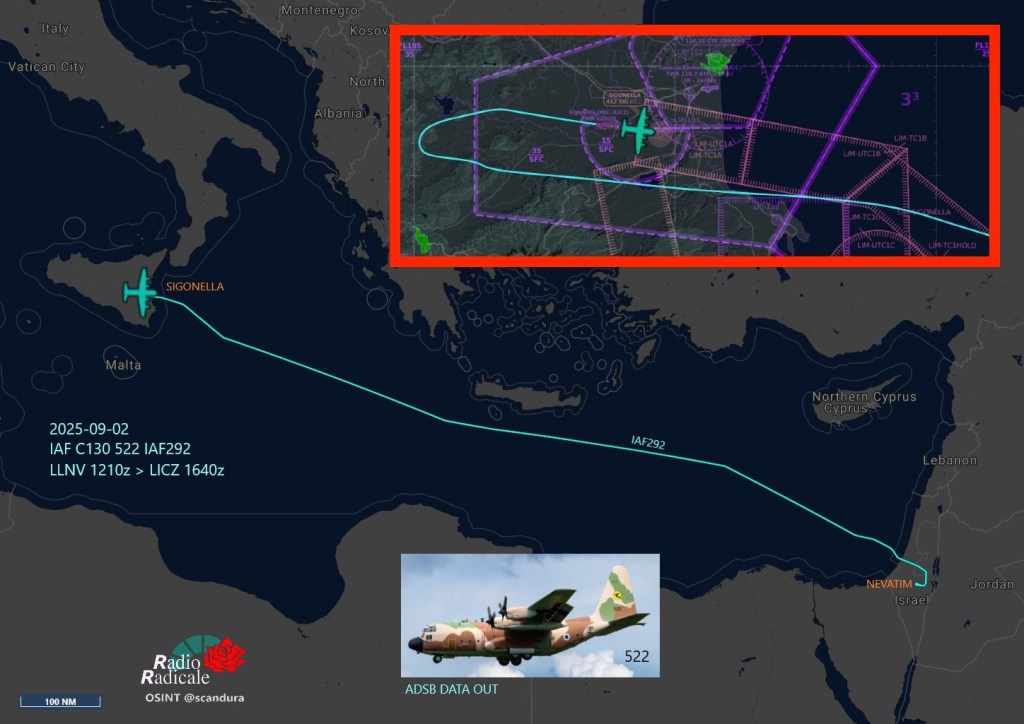
On the evening of August 31, three Israeli C-130 transports climbed out of Nevatim Air Base. Two of them landed at Sigonella in Sicily around 18:40 CEST and refueled for about three and a half hours before heading back. At the same time, two Nahshon ISR jets were tracked circling over the Strait of Sicily, keeping an eye on every ship below.
It lines up almost too neatly with the Global Sumud Flotilla’s schedule. The convoy left Barcelona on August 29, regrouped in Tunis on August 30, and by September 1 was steaming past Sicily and Malta with Greta Thunberg on board alongside volunteers from over forty countries. You might recall activists spotting drones buzzing their vessels near Menorca—not exactly friendly skies.
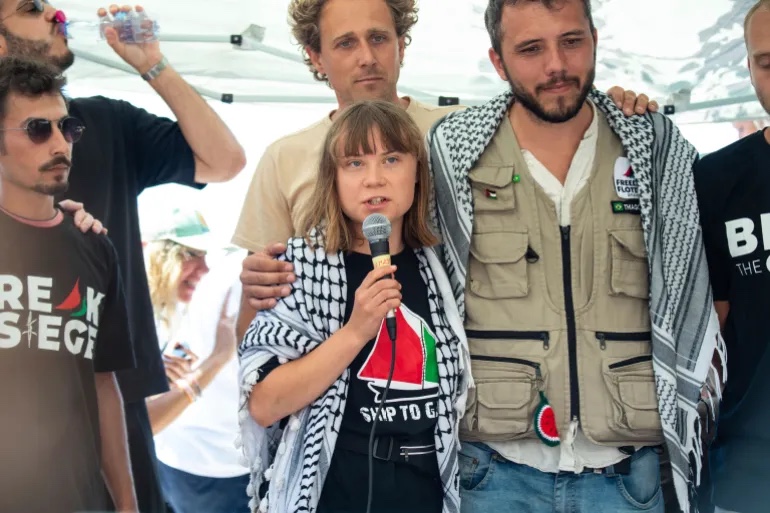
Greta Thunberg, centre, with Thiago Avila, right, speaks to journalists in Catania, Italy, on June 1, 2025 [Salvatore Cavalli/AP Photo]
Israel has a record of intercepting flotillas and deporting participants in international waters. Thunberg herself was turned back not long ago. Staging C-130s at Sigonella and orbiting ISR platforms so close feels like positioning for a maritime shadow operation.
If any of those flights drift into Italian or Maltese airspace, expect swift protests from Rome and Valletta. And if an Israeli ship or helicopter boards a humanitarian vessel again, we could see a diplomatic firestorm—not just words in the papers, but real regional fallout.
Keep an eye on AIS signals from the flotilla over the next couple of days. If you spot another C-130 loitering off Sicily around September 3 or 4, consider it your warning that tensions are heating up.
Will the aid convoy slip through unchallenged or meet another blockade at sea? We’re watching the flight paths as closely as you are to find out.
PS: The Global Sumud Flotilla did depart Barcelona on August 31 but ran into stormy weather and turned back to port on September 1 for safety. Organisers relaunched the convoy on September 2, and it’s now steaming toward its Tunis rendezvous before heading past Sicily and Malta again.
PS2: The flotilla is still moving on and Italian MP’s are boarding it.
PS3: From followers remarks on Facebook “..When Israel launches a space satellite, they always have the same kind of mission, this has nothing to do with the flotilla. Most of the aircraft deployed are used to follow on the mission, and see if any debris or other stuff can fall also on shipping in the Med…“
It makes sense to wonder if those C-130s and ISR jets were simply chasing rocket stages after the Ofek-19 launch. Israel does fly support missions whenever it sends a satellite into orbit—not just for telemetry and debris tracking, but to keep air and sea traffic clear of falling bits.
Still, when you look at what unfolded over Sicily and the Strait of Sicily a few days ago, a different picture emerges. These were three Hercules transports touching down at Sigonella for only a few hours, paired with two Gulfstream-based ISR aircraft loitering in tight circles right over the Flotilla’s route. Their sensors aren’t optimized for tracking rocket fragments—they’re configured for maritime domain awareness.
The timing lines up almost too neatly with the Global Sumud Flotilla’s path from Barcelona to Gaza, especially with high-profile passengers like Greta Thunberg on board. Past patrols and drone overflights in that same corridor were clearly aimed at monitoring aid ships. And Israel’s history of intercepting and deporting flotilla volunteers adds weight to the idea that these flights were about more than space debris.
That said, dual-purpose missions aren’t unheard of. It’s possible the aircraft carried out standard post-launch safety sweeps while also gathering maritime intelligence. The real clue will be what happens next—if we see these ISR patterns shift back to typical launch-support profiles, or if they continue to shadow civilian vessels.
Not long ago a Russian Kilo-class submarine slipped into view off Sicily under NATO escort. It wasn’t a shadowy legend this time but a real vessel cruising beneath the waves.
Spotting a sub in those waters feels like more than a stunt, doesn’t it? It speaks to a game of signals that plays out deep underwater yet echoes above the waves all the way to our Maltese shores.
At nearly the same moment, we saw a shift on the surface too. Washington has started tying market access to heftier defense bills in Europe. You buy more jets, you pay in advance, you carry more risk. And those jets may come without the keys to release their nuclear payloads. It’s a strange split between those who hold the code and those who don’t.
Take a glance at our neighbours. Some are rushing new drones, others discuss whether to host US bombs beyond 2030. A few talk about renting American deterrence while others build their own anti-air systems. Every move slides risk a little closer to the Central Med, waiting to spill over.
On the economic front the price of Brent flirted with ninety-nine dollars after a Houthi drone struck in the Red Sea. Tankers bent their course toward the Central Mediterranean, the very lanes which envelope the Maltese islands and which we have to, somehow, patrol.
Insurers are hiking premiums and every extra five dollars a barrel bites into refinery profits in Sicily and across the way. Closer to home Italy’s steel mill closure threw military steel plans into disarray. Refit delays at carriers and subs could stretch on for months.
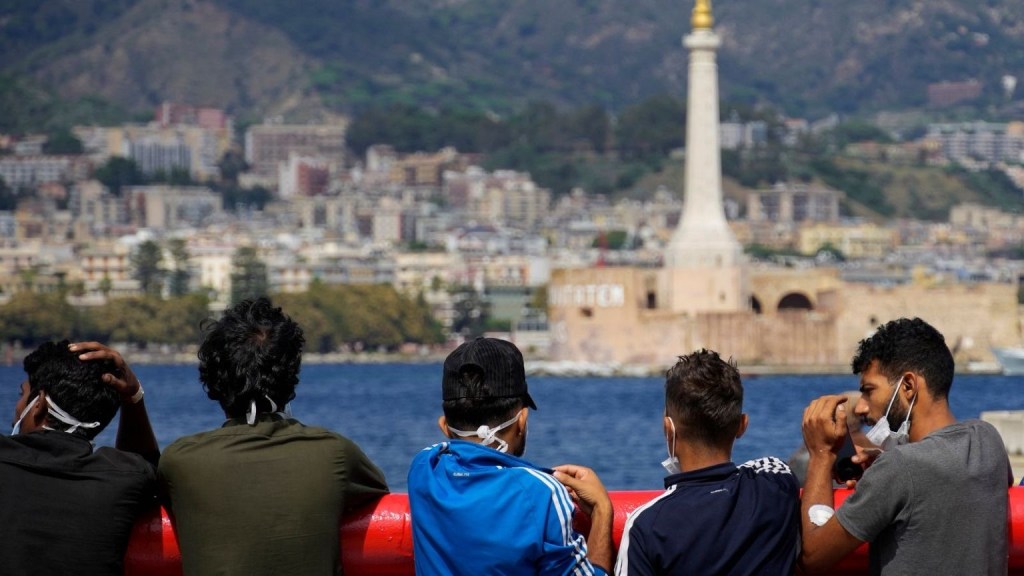
Then there’s the migration puzzle. Satellite shots show large camps south of Sabha ready to receive people by the tens of thousands. If that wave swings toward Malta and Sicily, our armed forces and rescue teams will be again tested on border control and humanitarian aid at the same time. We can almost see the Maltese government juggling energy shortages, spoofed GPS signals and sudden refugee flows.
Malta has to step up. Through our previous shared opinions, we’be been pushing for Malta to send drones and cyber kits into EU missions. It makes sense to argue for a shared fund so smaller countries aren’t squeezed by these tariff tactics.
Imagine a national centre fusing drone and satellite feeds to give us a clear picture of the Central Med. Joint drills with Italy and France will sharpen our skills and show that we’re a partner to be taken seriously.
In the end the pressure in our sea is more about choices than capacity. If we plan ahead, reach out to friends and build our own networks, we won’t just chase change. We’ll shape it. And that’s a strategy Malta can stand behind.
Am of the opinion that not much thought is given about how migration stories change shape across Europe when they reach our screens and pages. It’s almost like each country speaks its own language of news, even before translation takes place.
In Italy these days the focus often lands on rules and numbers. You’ll see quick reports of arrivals and statements from officials. The human faces behind those journeys can feel distant. Stories seem to serve policy debates more than they invite us into someone’s lived experience.
Turn to Germany and you’ll find a steady stream of frontline reports. Local papers run profiles of families finding their feet in small towns. Broadcasters follow integration projects as they unfold. Yet just a few hours east, Hungary treats the same arrivals almost purely as a threat. Migrants appear in headlines more as a problem to solve than as people in need.
In France and the UK migration tends to arrive through the lens of diplomacy. News breaks when Brussels meets Rome or when London strikes a deal with a North African government. Still, quality outlets often pause to share first-hand voices from the boats. You read personal notes on hope and loss alongside the policy talk.
Spain’s press shifted over the years from telling individual landing stories to mapping out EU negotiations. That move changed the tone. Sweden’s newspapers stayed closer to those first moments on the beach. They dwell on volunteers meeting newcomers at dawn, on small gestures that bridge two lives. Meanwhile some Central and Eastern European outlets frame migration almost entirely as a security issue. You’ll find little on rescue efforts or community welcome.
All these different angles matter because they guide what we believe and what we feel. When stories highlight human resilience we lean toward compassion. When they stick to decrees and barriers, fear tends to spread. Perhaps you’ve noticed your own mood shift after watching a certain channel or scrolling a particular site.
I have found myself often wondering how our shared understanding would change if every arrival sparked the same kind of human-centred reporting across borders. Would we feel more connected to each other, more ready to help in practical ways? Maybe that’s the kind of shift we need in our newsrooms and in our own habits of reading.
New visa fees stand to increase costs for travelers to the United States, but questions remain about when and how the fees will be implemented. Gary Hershorn | Corbis News | Getty Images
In July 2025, the “visa integrity fee” was signed into law, mandating that all nonimmigrant visitors pay at least $250 when their visas are issued. This surcharge comes on top of existing application fees and a newly hiked Form I-94 fee, which now stands at $24. The fee cannot be waived, and although it’s technically refundable if travelers obey all visa conditions, the reimbursement process is undefined and likely to resemble a bureaucratic maze
The $250 “Integrity Fee”: A Barrier, Not a Welcome Mat
I never imagined a trip to New York would carry a price tag for your honesty. Yet here we are.
Today the United States is asking every visitor to pay a 250 dollar fee simply to prove they mean no harm. I think that feels more like a guard at the gate than a welcome mat.
The new measure lands on top of all the usual charges. You pay to apply, then you pay again to verify your arrival and departure. The rules say this integrity fee can be refunded if you follow every requirement. The process to get your money back is vague at best. It seems you must navigate a maze of forms and wait on hold for hours. Many travelers might just let it go.
A Chilling Signal to EU Citizens
For those of us in Europe who have grown used to crossing borders with a shrug, this fee stings. We expect a handshake when we travel, not a deposit. Paying upfront as if we work on bond makes us pause. What kind of message does this send to someone planning a study trip or scouting a location for a film? Will they think twice before booking their ticket?
Big Brother at the Border: Orwellian Parallels
It all has a tinge of an Orwell story. Imagine needing to pay to prove you leave when your visit ends. It mirrors that notion that every step will be watched and tallied. The idea of a country asking for collateral on trust feels strangely backward.
Beyond the Fee: Surveillance, Trust, and Cultural Exchange
Travel is more than a passport stamp. It is the chance to hear voices you would never meet at home. As a documentary filmmaker as one of my less well known talents, I worry about the stories we lose when fewer people come. What happens to the festivals, the chance meetings at a cafe, the shared laughter on a crowded train?
A Call to Reclaim Openness
If you plan to visit soon, you might want to budget extra or look at other destinations. You might even raise a question with your local representatives. We all have a stake in keeping travel open and friendly, in making sure trust remains free.
Maybe this is a wake up call. We choose what kind of world we build with our passports and our fees. Will the USA keep borders open enough to share ideas or let the walls close in? I hope this moment turns into a conversation more than a bill.
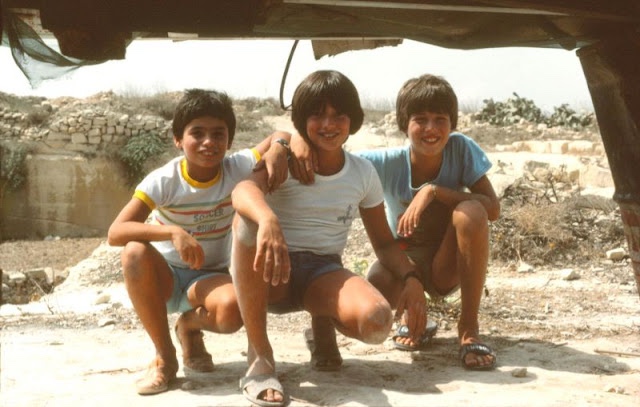
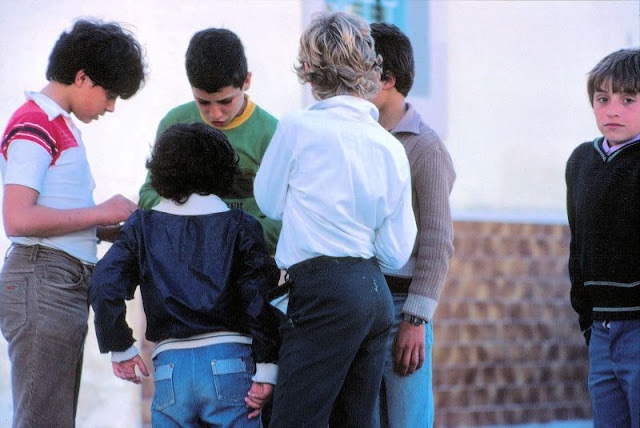
You know, when I think about what it meant to grow up in Malta, it honestly feels like a mix of soil or dust, salted skin, and stories you’d only ever trust if you’d lived them yourself.
There was a rhythm to those days—a quiet competition, maybe, or just a sense that adventure was never optional. You’d wake to sunlight slanting through the venetian blinds (by firm Joinwell!!), and the world outside pulled you off your couch before you could think about what you looked like.
Dirt crusted under your nails and knees scraped raw (oh, those countless scabs); those details seem small now, but at the time, that was proof you’d done something real.
You’d find yourself slipping through the fields still then surrounding your neighbourhood, or crouching behind low rubble walls (carefull not to dismantle it accidently as one rock of the ‘ħajt tas-sejjiegħ’ beckons another after it!), waiting to spot the flicker of some rare wild rabbit through the grass or the flutter of a small bird – more often than not a Spanish Sparrow – near your homemade trap, made from chicken cage wire nicked from Dad’s or Nannu’s garage!
Sometimes, all you’d catch was the wind rattling the fennel and the laugh of a friend further up the path, and honestly, I find myself missing the chase as much as the catch.
Afternoons belonged to the sea. Some days, we’d haul homemade nets and battered rods to the shoreline, hoping—really hoping—that our home acquarium’s next addition might wiggle at the end of a trembling line.
There was seasalt on our lips and quiet in our ears, just the brush of waves and the engine noise from luzzu boats out beyond the point. I’ll be honest, I learnt that fishing was half waiting, half dreaming, but I don’t recall ever feeling bored given the good company I was with.
Now, it’s different. I watch kids everywhere today hunched over their phones, fingers flying but feet perfectly clean. They’re hunting, too, in their way—chasing a WiFi signal, not a rabbit or a sparrow, and hoping for a connection that doesn’t spin out of reach.
Instead of secret forts and coves or sandy silence, it’s the buzz of a message or the slow load of a video on their smart devices. I guess you could ask: does the thrill hit the same way? Is there still that surge of wild hope when they find what they’re chasing, even if it’s just a steady internet bar instead of a startled bird in the grass?
Sometimes, I wonder if the messiness—the stings and salty hair, the feeling that the day could break open with the next discovery—is really gone, or if curiosity just shifted form. I think it’s easy to get nostalgic, but honestly, I notice kids still lean forward, still search for something just beyond easy reach. Curiosity has new tools now, but the pulse underneath isn’t so different.
Maybe you remember a moment like this: holding something unpredictable, feeling the world tilt a little because you managed to grab whatever it was—a fish, a memory, a small moment—without knowing what would happen next. That feeling, the little jolt of chaos, sticks with you. Maybe it’s still possible to find, even through a tangle of cables or the haze of a screen.
It’s hard not to miss rough hands and sandy shoes, but I try to believe the important things—curiosity, luck, a willingness to get a little messy for something real—they stumble forward, no matter how much the surface changes.
There’s something quietly unsettling about calling tech support and hanging up feeling even more lost. You reach out hoping for a lifeline, only to find yourself drifting further away from clarity.
On one end, you’re wrestling with a problem that’s probably urgent, maybe even a little embarrassing. On the other, there’s someone who speaks a language that feels just out of reach—full of codes, steps, and acronyms.
The more they explain, the less you seem to understand. It’s like shouting across a canyon and hearing only echoes.
Let’s talk about what really happens in those moments.
Empathy Isn’t Just a Bonus
Most support calls start with a script. “Have you tried restarting?” might be the most common phrase in tech. It’s oddly comforting, but it can also feel like the person on the other end isn’t really listening. When you’re stressed, maybe because your work is on hold or your small business can’t function, you need more than a checklist. Real empathy changes the whole experience. It’s not about being nice for the sake of it—it’s about making you feel seen. When support feels like a conversation, not an interrogation, you’re more likely to walk away with real answers.
Knowing Isn’t the Same as Explaining
It’s easy for experts to forget what it’s like to be new to something. Throwing around technical terms can make things worse. The real skill is in making the complicated simple. If you’re explaining a blackout to a kid, you don’t start with the science—you talk about the lights going out and people working hard to fix it. In tech support, finding those simple stories or comparisons can turn confusion into understanding. Maybe your router is like a post office, sorting and sending out information. Suddenly, it all makes a bit more sense.
Jargon Can Wear You Down
Every time a call ends without a clear answer, your confidence takes a hit. You start to wonder if you’re just not cut out for this stuff. Maybe you bought the wrong thing. Maybe you should have paid someone else to fix it. After a while, it’s tempting to just stop asking for help at all. That’s a real loss. It means people give up on learning, and on trusting the technology they use every day.
What If We Changed the Script?
Imagine if support was measured by how well you understood the solution, not just how quickly the call ended. What if the last question wasn’t, “Is your problem fixed?” but, “Can you tell me how you’d handle this next time?” Or maybe AI could listen in and nudge the agent when things get too technical: “Try that again, but in plain language.” It’s a small shift, but it could change everything.
You Deserve to Understand
You don’t need to be an expert to ask for clear answers. Next time you’re on the line, try saying, “I know you know your stuff, but I know what I need. Can you walk me through why we’re doing each step?” Make the person on the other end your guide, not just a voice reading from a script. You have a right to hang up feeling like you learned something, not like you missed a step.
Beyond the Frustration
This isn’t just about tech support. It’s about how we interact with technology in general. Too often, it feels cold and distant. What would it look like if every interaction felt a little more human? Maybe AI could help by noticing when you’re confused, offering a bit of encouragement, or even cracking a joke to break the tension.
If you’ve ever gotten lost in a sea of jargon, you’re not alone. Maybe you’ve had a support call that went surprisingly well, or one that made you want to give up. Those stories matter. They’re how we figure out what actually works.
Maybe the real fix isn’t just better answers, but better conversations. That’s something worth reaching for.
There’s something quietly absurd about the way certain brands go about naming everyday things. The coffee industry’s infamous sizing system—where “tall” means small and “venti” feels like you’re ordering in an opera—has become a kind of inside joke people are too exhausted to laugh at.
It’s packaging pretension as sophistication. And maybe they think it’s clever, but really it’s just putting lipstick on a cup of brown liquid we all rely on to survive the morning.
This chalkboard sign flips the whole performance on its head. It’s blunt. A touch cheeky. More honest than most corporate branding departments dare to be. “Flat white = white coffee.” Simple. There’s no drama. No Italian vocabulary test before you’ve had your caffeine. It’s the antidote to the nonsense. What some call elegance, others might call marketing theatre.
There’s a kind of strange irony in naming a plain old milk-heavy coffee a “latte” just to sound continental. Especially when the language it’s borrowed from has been making coffee for centuries without a global branding workshop.
The names weren’t invented to dazzle—they just described what was in the cup. But at some point someone realised that throwing in a foreign word makes things feel more ‘premium’. So now we have drinks with names longer than the small talk at the counter.
And it’s not just coffee. You’ll see it with things like “artisanal hydration” (bottled water) or “curated grazing boards” (cheese and crackers). It’s theatre dressed as logic, a kind of self-aware silliness that thinks it’s clever—but really, it’s just noise.
If you strip it all back, people just want good stuff, served with clarity and a bit of charm. Not a lesson in nomenclature.
This café blackboard proves you can poke fun at the whole act and still serve a decent brew.
Maybe that’s what we need a bit more of—less drama, more coffee.
I sometimes pause when I think about how Malta has built its naval fleet over the past twenty years. It starts with a clear need, a bold announcement even, and then… a long wait.
When the P61 joined the fleet, the AFM Commander at the time, Brigadier Carmel Vassallo, pointed out right away to Jane’s Defence Weekly that a sister ship would help share the workload. And yet no second vessel of that class ever arrived. Instead, there was a patchwork of stopgaps and short-term fixes.
One of those fixes was a donated ship that many insiders saw as past its prime. It filled a hole for a moment but did little to show a long-term plan or a budget set aside for fleet renewal.
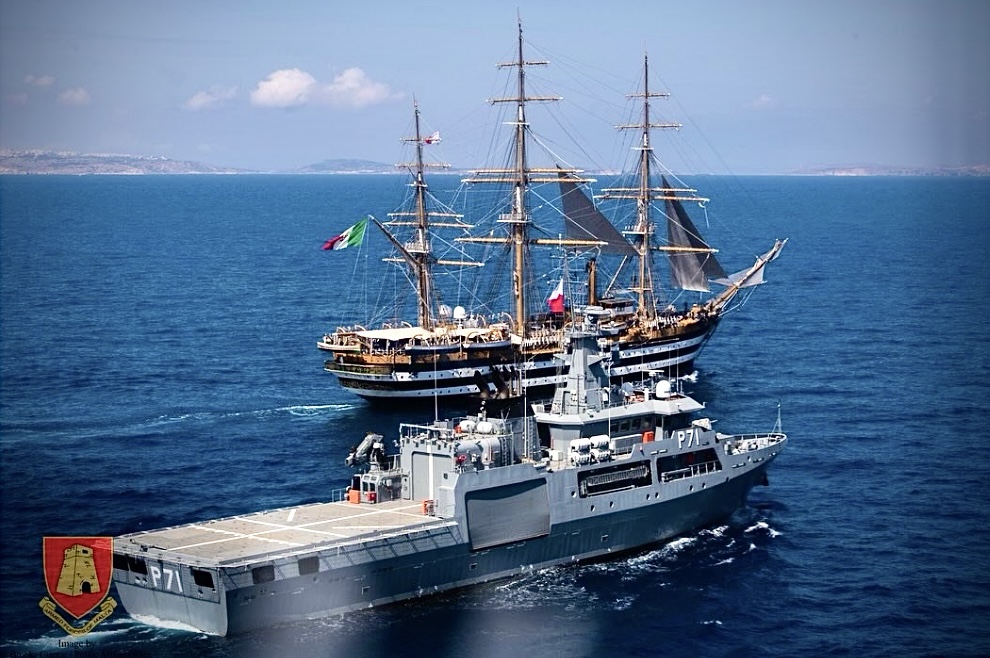
The real game-changer came only with the P71, and only because more than half of its price tag came from EU support. That kind of outside help was welcome, but it makes you wonder what Malta’s own budget might have covered if the funds had been there.
It almost feels as if decisions come only when a crisis appears. We spot a gap, we scramble for a quick solution, and then we wait for the next alarm bell. Do we want to keep reacting like that, or start thinking a few steps ahead?
Meanwhile, the armed forces have filled roles far from classic defense. From search-and-rescue to fisheries patrols, they juggle civilian tasks and military ones. That shift sounds practical, but it also pulls attention away from core defense missions.
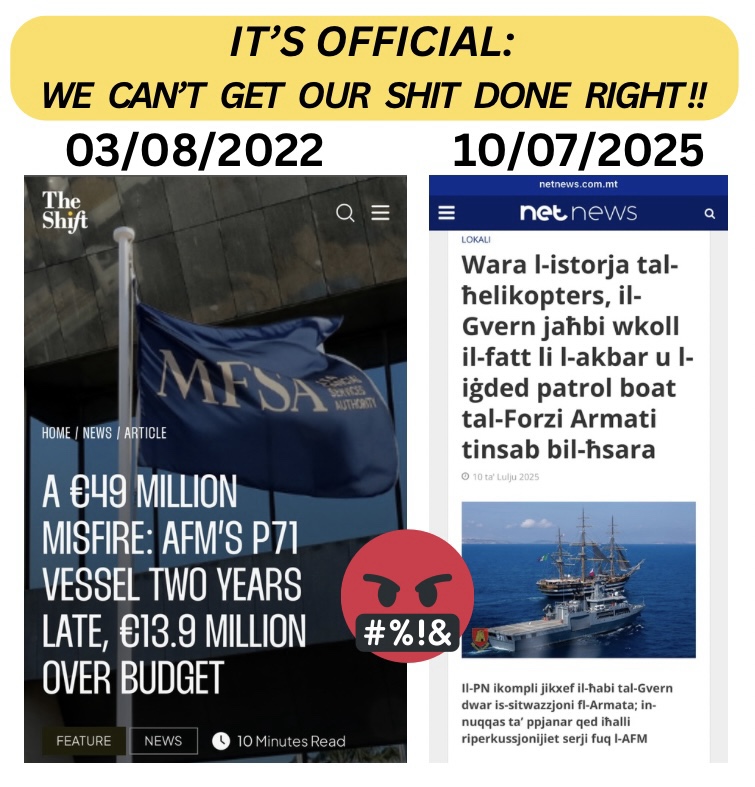
When P71 finally set sail, it was two years late and millions of euros over the original estimate. That kind of drift in time and money can shake the public’s trust. It raises questions about how projects are managed from the very first sketch on paper.
I think part of the answer lies in leadership that sees the big picture. Without a shared roadmap, every new purchase feels like a solo act. A fleet doesn’t grow through isolated choices but through a sequence of decisions that build on each other.
Malta stands at a crossroads. Will we keep patching holes with donated or off-the-shelf solutions? Or will we invest in a fleet that reflects our security needs and our ambitions for the Mediterranean?
Perhaps it’s time to set aside gestures that fill gaps for a season and focus on a plan that lasts. A clear vision and steady funding could change the way Malta sees itself at sea.
I’ll leave it at that, with the hope that a fresh conversation on defense might spark a shift in how we guard our waters—and how we budget for what really matters.
I sometimes pause when I think about how Malta has built its naval fleet over the past twenty years. It starts with a clear need, a bold announcement even, and then… a long wait.
When the P61 joined the fleet, the AFM Commander at the time, Brigadier Carmel Vassallo, pointed out right away to Jane’s Defence Weekly that a sister ship would help share the workload. And yet no second vessel of that class ever arrived. Instead, there was a patchwork of stopgaps and short-term fixes.
One of those fixes was a donated ship from Ireland that many insiders saw as past its prime. It filled a hole for a moment but did little to show a long-term plan or a budget set aside for fleet renewal.
The real game-changer came only with the P71, and only because more than half of its price tag came from EU support. That kind of outside help was welcome, but it makes you wonder what Malta’s own budget might have covered if the funds had been there.
It almost feels as if decisions come only when a crisis appears. We spot a gap, we scramble for a quick solution, and then we wait for the next alarm bell. Do we want to keep reacting like that, or start thinking a few steps ahead?
Meanwhile, the armed forces have filled roles far from classic defense. From search-and-rescue to fisheries patrols, they juggle civilian tasks and military ones. That shift sounds practical, but it also pulls attention away from core defense missions.
When P71 finally set sail, it was two years late and millions of euros over the original estimate. That kind of drift in time and money can shake the public’s trust. It raises questions about how projects are managed from the very first sketch on paper.
I think part of the answer lies in leadership that sees the big picture. Without a shared roadmap, every new purchase feels like a solo act. A fleet doesn’t grow through isolated choices but through a sequence of decisions that build on each other.
Malta stands at a crossroads. Will we keep patching holes with donated or off-the-shelf solutions? Or will we invest in a fleet that reflects our security needs and our ambitions for the Mediterranean?
Perhaps it’s time to set aside gestures that fill gaps for a season and focus on a plan that lasts. A clear vision and steady funding could change the way Malta sees itself at sea.
I’ll leave it at that, with the hope that a fresh conversation on defense might spark a shift in how we guard our waters—and how we budget for what really matters.













 The Cons's Nook: www.ivanmconsiglio.com
A European Union Citizen’s Wake-Up Call: When Travel Turns Into Compliance
Gary Hershorn | Corbis News | Getty Images
In July 2025, the “visa integrity fee” was signed into law, mandating that all nonimmigrant visitors pay at least $250 when their visas are issued. This surcharge comes on top of existing application fees and a newly hiked Form I-94 fee, which now stands at $24. The fee cannot be waived, and although it’s technically refundable if travelers obey all visa conditions, the reimbursement process is undefined and likely to resemble a bureaucratic maze
The $250 “Integrity Fee”: A Barrier, Not a Welcome Mat
I never imagined a trip to New York would carry a price tag for your honesty. Yet here we are.
Today the United States is asking every visitor to pay a 250 dollar fee simply to prove they mean no harm. I think that feels more like a guard at the gate than a welcome mat.
The new measure lands on top of all the usual charges. You pay to apply, then you pay again to verify your arrival and departure. The rules say this integrity fee can be refunded if you follow every requirement. The process to get your money back is vague at best. It seems you must navigate a maze of forms and wait on hold for hours. Many travelers might just let it go.
A Chilling Signal to EU Citizens
For those of us in Europe who have grown used to crossing borders with a shrug, this fee stings. We expect a handshake when we travel, not a deposit. Paying upfront as if we work on bond makes us pause. What kind of message does this send to someone planning a study trip or scouting a location for a film? Will they think twice before booking their ticket?
Big Brother at the Border: Orwellian Parallels
It all has a tinge of an Orwell story. Imagine needing to pay to prove you leave when your visit ends. It mirrors that notion that every step will be watched and tallied. The idea of a country asking for collateral on trust feels strangely backward.
Beyond the Fee: Surveillance, Trust, and Cultural Exchange
Travel is more than a passport stamp. It is the chance to hear voices you would never meet at home. As a documentary filmmaker as one of my less well known talents, I worry about the stories we lose when fewer people come. What happens to the festivals, the chance meetings at a cafe, the shared laughter on a crowded train?
A Call to Reclaim Openness
If you plan to visit soon, you might want to budget extra or look at other destinations. You might even raise a question with your local representatives. We all have a stake in keeping travel open and friendly, in making sure trust remains free.
Maybe this is a wake up call. We choose what kind of world we build with our passports and our fees. Will the USA keep borders open enough to share ideas or let the walls close in? I hope this moment turns into a conversation more than a bill.
#VisaIntegrityFee #TravelDebate #OpenBorders #BigBrotherState
Read more and all at the link below:
CNN TRAVEL DEPORT: Visiting the US will soon require a $250 ‘visa integrity fee’
Share this: