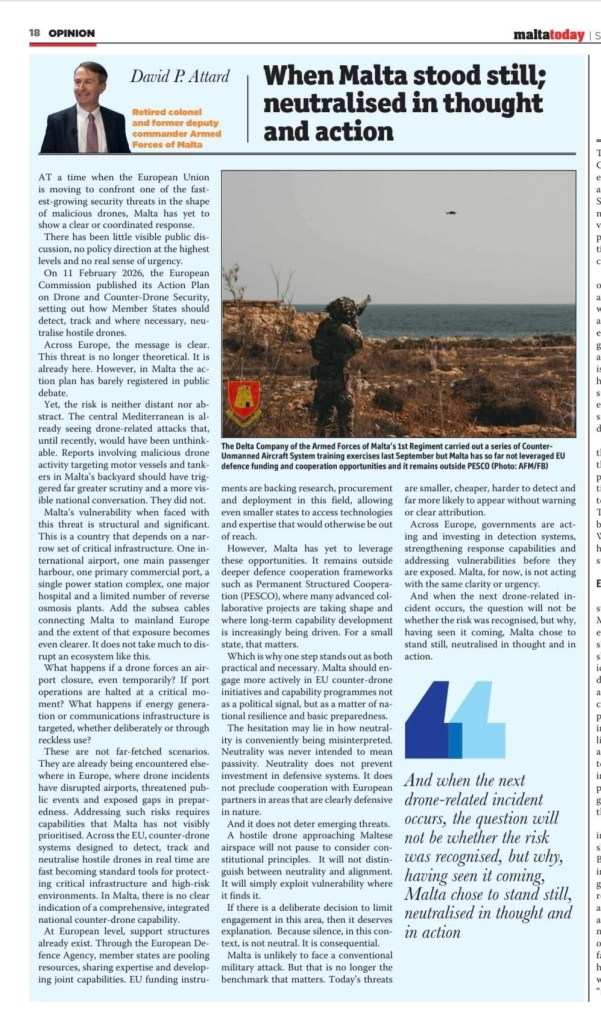
Malta is drifting through a security environment that has already changed, and the uncomfortable part is that everyone else seems to have noticed except us.
Across Europe, drones have shifted from being a hobbyist nuisance to a daily operational factor. Airports disrupted. Energy sites probed. Border regions tested.
The EU responded by building detection grids, counter‑UAV doctrine, and rapid‑response layers that mix sensors, jammers, guns, missiles, and civil‑military coordination.
Meanwhile, we’re still debating whether preparing for any of this somehow violates neutrality, as if a hostile drone will politely consult our Constitution before crossing the shoreline.
Colonel David ‘dp’ Attard’s argument lands because it’s grounded in reality, not theatrics.
Malta’s infrastructure is compact to the point of fragility: one airport, one main port, one power station, a few desalination plants, a handful of subsea cables. A single drone incident in any of these nodes would ripple across the entire country.
That’s not fear‑mongering; it’s basic maths. Small states don’t get the luxury of redundancy. When something breaks, it breaks loudly.
What makes this even stranger is that the tools already exist. The EU is pouring money into counter‑drone research, joint procurement, and shared training. These programmes were designed for countries exactly like Malta — small, resource‑limited, and exposed.
Yet we’ve chosen to sit out, insisting that neutrality means abstaining from defensive cooperation. It doesn’t. Neutrality never meant self‑inflicted blindness. It never meant refusing sensors, refusing training, refusing the ability to detect a threat before it’s already overhead.
From an air‑defence artillery perspective, the gap is even more obvious. Traditional AAA was built for fast jets, not palm‑sized UAVs with tiny radar signatures and erratic flight paths.
Modern counter‑UAV defence starts with detection: radar tuned for slow, low‑RCS targets, passive RF sensors, electro‑optical tracking, and a command node that fuses all of it into a single picture. Without that, no gun, jammer, or missile matters.
You can’t intercept what you can’t see. And without a layered response — soft‑kill for low‑risk intrusions, hard‑kill for hostile ones — you’re left with a ridiculous binary: ignore it, or escalate immediately. That’s not a strategy; it’s a gamble.
The irony is that none of this requires Malta to become something it isn’t. It doesn’t require alliances, bases, or foreign troops. It requires competence. It requires acknowledging that the threat profile has evolved faster than our institutions.
It requires accepting that drones don’t care about our political narratives. They care about physics, opportunity, and the absence of detection.
If we continue treating counter‑UAV capability as optional, we’re effectively betting the country on hope. Hope that no one tests our airspace. Hope that no one targets our infrastructure. Hope that the Mediterranean remains quiet. But hope is not a security posture, and it certainly isn’t a plan.
Europe has already adapted. The threat has already arrived. The only thing still standing still is us — neutral not by principle, but by paralysis.